- Crypto Intel
- Posts
- Bitcoin Back Above $71K, But Regulation and the EU Could Decide What's Next
Bitcoin Back Above $71K, But Regulation and the EU Could Decide What's Next
Ceasefire lifts BTC, yield fears hit USDC, and the ECB builds digital rails.
Bitcoin just reclaimed $71K on ceasefire headlines, Circle stock got punched on stablecoin yield fears, and the ECB is quietly laying the rails for a digital euro. If you are trying to decide whether to lean risk-on or stay cautious, this mix of geopolitics, regulation, and infrastructure matters more than today's green candles.
This is not random noise. It is capital reacting to war, Washington, and central banks—all at once.

Next Stage (Sponsored)

Many investment banks just raised their targets to $6,000/oz... mere weeks after predicting $5,000.
Even Jim Cramer now admits to being a "gold bug."
But nearly everyone is missing an even bigger story: the absolute best way to invest in gold right now.
Market-Moving News
Three forces are shaping your positioning right now: Bitcoin trading off a 15-point US ceasefire proposal to Iran, US lawmakers threatening stablecoin reward models, and the ECB accelerating digital euro standards. Oil is cooling, crypto stocks are wobbling, and Europe is building state-backed rails in the background.
In the short term, you are trading headlines and regulatory drafts. In the bigger picture, you are watching how risk appetite, stablecoin economics, and sovereign digital money collide—and that collision could define the next leg of this cycle.
Markets
Bitcoin Retakes $71K as US Sends Iran 15-Point Ceasefire Plan

Bitcoin climbed back above $71,000 during early Asian trading after President Trump's administration sent Iran a 15-point proposal aimed at ending the war. The move sparked short-term optimism across risk assets and erased most of Tuesday's slide below $69,000.
BTC jumped as much as 4% from local lows near $68,890 to around $71,300, recouping the prior day's losses. Analysts said the market is once again treating Bitcoin as a real-time gauge of geopolitical risk.
Oil Slides, Risk Breathes
WTI crude dropped nearly 6% toward $87, and Brent fell around 6% to $98 as ceasefire headlines cooled fears of supply disruption. Gold extended gains while inflation worries tied to the Strait of Hormuz temporarily eased.
Lower oil reduces pressure on yields and risk assets, giving Bitcoin room to bounce. For now, you are trading diplomacy headlines as much as technical levels.
Resistance Ahead
Despite the rebound, Bitcoin faces heavy resistance above $72,000, where technical and cost-basis clusters converge. Glassnode data shows roughly 380,000 BTC accumulated between $72,000 and $74,000 over the last month, a zone sellers may defend aggressively.
On the downside, strong accumulation sits near $65,000, and losing that level could open the door toward $52,500 if bearish structures confirm. Capriole's Bitcoin Macro index is back in "value zone" territory, but historically that has often preceded deeper drawdowns before recovery.
Take: You are trading headlines first and fundamentals second, and that can flip fast. If oil stabilizes and de-escalation signals become official, upside can extend—but resistance near $72,000 to $74,000 means you should expect turbulence before any clean breakout.
Stablecoins
Circle Slides 20% as Clarity Act Draft Targets Stablecoin Rewards

Circle shares plunged 20%, and Coinbase fell nearly 10% after a new draft of the Clarity Act raised the prospect of strict limits on stablecoin yield. The proposal would bar rewards on passive balances and ban structures deemed "economically equivalent to interest."
That directly challenges the pass-through model where Circle earns interest on USDC reserves and shares revenue with Coinbase to fund user rewards. Stablecoin yield has been a key incentive driving adoption beyond simple payments.
Yield Under Pressure
Analysts warned that banning rewards could weaken USDC's near-term appeal and limit its path toward becoming a store-of-value product. The draft goes further than previous legislation by targeting indirect yield structures, not just issuer-paid interest.
At the same time, Tether said it hired a Big Four accounting firm for a full audit of USDT reserves. If successful, that could strengthen USDT's institutional positioning and intensify competition with USDC.
Overreaction or Reset?
Circle shares had rallied about 170% since early February, leaving them vulnerable to sharp pullbacks on negative headlines. Some analysts argue the sell-off may be exaggerated, noting stablecoin use cases are expanding beyond rewards into payments and infrastructure.
Circle still controls roughly 30% of a market projected to grow significantly over the next several years. Workarounds such as loyalty-style programs could potentially replicate incentives without violating interest bans.
Take: You are seeing regulatory risk hit fast money first, not necessarily long-term adoption. If reward structures shrink, growth may slow in the short run—but the broader stablecoin infrastructure story remains intact as long as payments, compliance, and institutional demand keep expanding.
If you had to bet, what percentage of today’s top 50 coins still exist in 10 years? |
Rising Crude (Sponsored)

The recent move in oil prices has put the energy sector back in focus.
Large banks have raised their outlooks for crude, and investors are reexamining which companies could benefit most if supply risks remain elevated.
In a new report, Zacks highlights three oil stocks that stand out based on the current market backdrop.
View the briefing.
*The results listed above are not (or may not be) representative of the performance of all selections made by Zacks Investment Research's newsletter editors and may represent the partial close of a position. Access grants you a comprehensive list of all open and closed trades.
*This free resource is being sent by Zacks.com. We look for investment resources and inform you of these resources, which you may choose to use in making your own investment decisions. Zacks is providing information on this resource to you subject to the Zacks "Terms of Service".
CBDCs
ECB Targets Summer for Digital Euro Standards

European Central Bank Executive Board member Piero Cipollone said the ECB aims to finalize technical standards for a potential digital euro by this summer. That would allow banks and merchants to begin preparing payment systems ahead of any issuance decision.
Once standards are announced, payment providers could embed the required rails into terminals and apps before EU legislation is finalized in 2026. The pilot phase is expected to run for 12 months starting in the second half of 2027.
Costs vs Control
Earlier ECB estimates suggest banks could face 4–6 billion euros in implementation costs over four years, roughly 3% of annual IT budgets. Cipollone argued those costs should be weighed against the long-term benefit of retaining merchant fees within Europe.
The digital euro is designed as public infrastructure used by private intermediaries, not a direct retail product from the ECB. It is intended to complement cash and bank deposits while reducing reliance on international card networks.
Tokenized Future in Sight
Cipollone also pointed to projects like Pontes and Appia aimed at settling tokenized securities in central bank money. He suggested tokenized central bank money could eventually serve as a settlement asset for stablecoins and tokenized deposits.
The ECB wants central bank money to remain the anchor in future wholesale markets. That signals Europe is thinking beyond retail payments toward a broader tokenized financial ecosystem.
Take: You are watching Europe quietly build payment infrastructure that could reshape settlement and cross-border flows over the next decade. The digital euro will not move markets tomorrow, but it strengthens the long-term case that tokenization and state-backed digital rails will coexist with stablecoins rather than replace them.
Coin Leaderboard
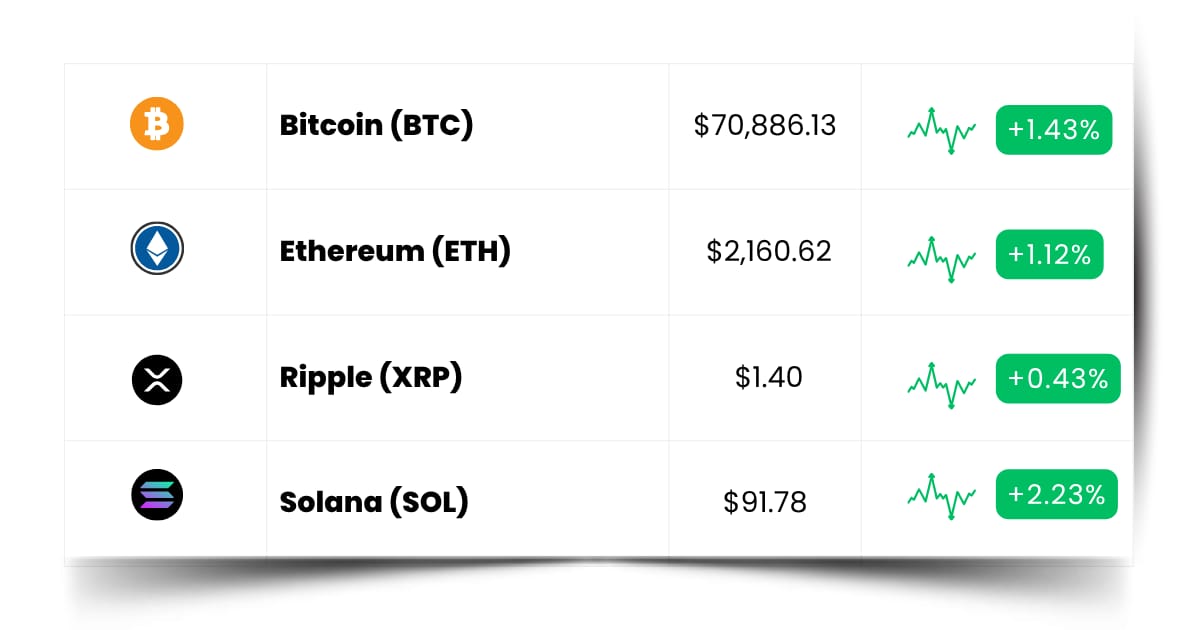
Crypto Pulse
Bitcoin is wrestling with $72K resistance after a ceasefire proposal cooled oil and lifted risk appetite—but under the surface, traders are swinging for the fences. PLAY detonated 948.28%, SIREN roared back 128.80%, and BSB ripped 89.79% as short-term capital ignored macro caution and chased pure momentum.
You are watching a split market in real time: institutions parsing geopolitics, stablecoin regulation, and digital euro standards, while fast money hunts volatility wherever it appears. If you only focus on Bitcoin's range, you miss where risk appetite is actually expressing itself today.
PlaysOut (PLAY) $0.04425 (-0.96%)
PLAY is in full breakout mode, ripping 948.28% in just 24 hours and leaving most of the market in the dust.
Siren (SIREN) $2.38 (+131.56%)
After a sharp drawdown, SIREN snapped back with a 128.80% surge, reclaiming most of its recent losses in a single session.
Block Street (BSB) $0.1579 (+93.92%)
BSB joined the rebound party, climbing 89.79% after several days of decline.
Growth Signals (Sponsored)
Every market cycle produces a handful of companies that dramatically outperform the rest.
Our latest screening has identified the 5 Stocks Set to Double — each showing rare traits linked to early-stage momentum.
These companies carry the same types of indicators that historically precede strong rallies.
Past reports highlighted stocks that surged +175%, +498%, and +673%.
Get the Free 5 Stocks Set to Double Report
*Results may not represent all stock picks and may reflect partially closed positions. Investing involves risk, and past performance does not guarantee future results. This is not financial advice.
Future Forward
The biggest crypto wins rarely start on the timeline—they start in rooms most people skip. If you want an edge, you watch where builders gather, not where influencers post.
Crypto conferences are where narratives quietly form before they hit your feed. When the same project shows up in keynote slides, hackathon demos, and investor side events, that is attention concentrating before price catches up.
Airdrops are not lottery tickets. They reward the wallets that test products, move funds, stake early, and participate when the Discord still feels empty.
Token launches are pressure tests. The first days tell you whether there is real demand, sticky community support, and disciplined liquidity—or just short-term hype dressed up as a roadmap.
Crypto Conferences:
💎 ETHCapeTown 2026 (Mar 26, 2026)
💎 Digital Euro Conference 2026 (Mar 26, 2026)
💎 Tech Unite Africa (Mar 26, 2026)
Upcoming Airdrops:
🎁 SoSoValue (SOSO) Airdrop (May 2026)
Upcoming Token Launches:
🚀 Mezo TGE and Distribution (Q1 2026)
🚀 EarnPark (PARK) Token Sale (Apr 13, 2026)
🚀 EarnBIT (EBT) TGE and Distribution (Q2 2026)
Which event are you most excited for? Let us know!
Crypto Know-How: What Is RLUSD?
RLUSD is Ripple's US dollar-backed stablecoin. It is designed to hold a steady $1 value while moving on blockchain rails, giving institutions a programmable way to settle payments.
Think of it as a digital dollar built for compliance-first environments. It runs on the XRP Ledger and is structured to meet regulatory standards that banks and large companies actually care about.
What makes RLUSD different is its focus on real business use cases like trade finance and cross-border settlement. Instead of just sitting on exchanges, it is being tested for automated payments that trigger when shipment or contract conditions are met.
For you, that matters because stablecoins that plug into real financial workflows tend to stick around. If RLUSD gains traction with regulators and enterprises, it strengthens the broader case that stablecoins are becoming core financial infrastructure—not just trading tools.
Everything Else
Bitcoin ETFs pulled in nearly $2.5 billion over the past month, almost erasing year-to-date outflows despite a 40% drawdown from the October high, showing that institutional buyers are still stepping in even when price action looks shaky.
Gold just logged its longest losing streak in over a century while Bitcoin held above $70,000, pushing the BTC-to-gold ratio up roughly 30% since late February and reinforcing Bitcoin's relative strength narrative.
Ripple is piloting its RLUSD stablecoin inside Singapore's central bank sandbox to automate cross-border trade payments, signaling that regulated, programmable settlement is moving from theory to real enterprise testing.
Irish authorities cracked the first of 12 seized Bitcoin wallets worth $34 million with Europol's help, unlocking part of a 6,000 BTC stash that has ballooned to over $400 million since 2019.
11 US states are moving against prediction markets like Kalshi with bans, lawsuits, and even criminal charges, setting up a federal showdown over whether these platforms fall under gambling law or CFTC oversight.
You don't need to chase every breakout or panic at every dip. Stay close to where capital, developers, and regulators are positioning early—and let that guide you before the charts catch up.
Best Regards,
— Benjamin Vitaris
Crypto Intel