- Crypto Intel
- Posts
- Bitcoin Remains Weak, But Big Money Isn't Leaving
Bitcoin Remains Weak, But Big Money Isn't Leaving
Bitcoin is slipping, and traders are hedging for more downside, but ETF investors just poured $1 billion back into the market.
At the same time, Ethereum is quietly preparing for a future where quantum computers could threaten today's cryptography.
That combination matters to you because it shapes three things: short-term risk, institutional conviction, and long-term network security.
If you want to know whether to defend, accumulate, or zoom out, this is where you focus.

Unexpected Source (Sponsored)

His salary is $400,000 a year.
But his tax returns show he collects up to $250,000 a MONTH from one source.
It's not real estate.
It's not stocks.
Discover what it is... And how you can get in for less than $20
Never Miss a Game-Changing Crypto Play Again!
We now send our daily picks via text, too, so you’ll get the same powerful content right on your phone.
Market-Moving News
Right now, you are watching three forces collide.
Derivatives traders are buying protection, ETF buyers are stepping back in, and Ethereum's roadmap is signaling long-term infrastructure upgrades.
In the short term, that creates tension between defensive positioning and dip accumulation.
Over the longer term, it tells you that institutional flows and protocol resilience—not hype—are the real drivers of where this cycle heads next.
Markets
Bitcoin Slips as Traders Hedge for More Pain

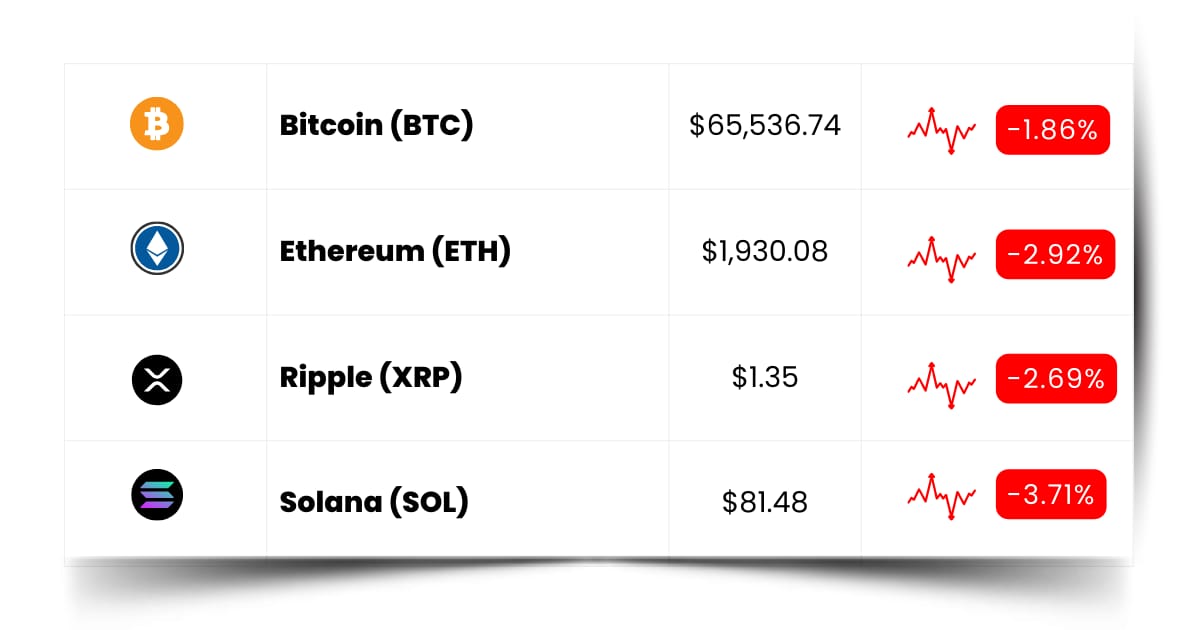
Bitcoin is back under pressure, falling roughly 2% in 24 hours and struggling to hold momentum after a brief push toward $70,000.
Ether, XRP, Solana, and the broader CoinDesk 20 Index are posting similar losses, reminding you that this is not an isolated weakness.
Under the surface, derivatives markets show caution building again.
Traders are actively buying put options, especially at the $60,000 strike expiring six to 12 months out, signaling demand for downside protection.
Derivatives Flash Defensive Positioning
Total crypto futures open interest has dropped to around $93.5 billion, erasing the optimism sparked by this week's bounce.
Long-short ratios continue to favor bearish bets, and negative funding rates across major tokens suggest shorts are regaining control.
On Deribit, one-month Bitcoin puts still trade at a premium to calls, and put spreads dominate block flows.
Participation in CME Bitcoin futures has also fallen to yearly lows, which tells you institutions are not rushing back in yet.
AI Tokens and Decred Break the Pattern
Not everything is red. Decred has jumped 16% in 24 hours and is up more than 80% over four weeks after a treasury rule change, making it the top performer among large tokens.
Meanwhile, AI-linked tokens like Internet Computer, Render, and Bittensor caught a bid following Nvidia's strong earnings.
A proposal from the DFINITY Foundation to burn 20% of cloud engine revenue added a deflationary angle to Internet Computer's story.
Take: You are looking at a market that is hedging first and hoping later.
Until futures positioning and funding rates flip convincingly positive, rallies may struggle—but selective narratives like AI and governance upgrades can still outperform if momentum sticks.
ETFs
Spot Bitcoin ETFs Pull In $1B as Dip Buyers Step Up

US spot Bitcoin ETFs attracted more than $1.02 billion in net inflows over three trading sessions this week.
That reversal came even as Bitcoin remains well below its prior highs, suggesting some investors see value at these levels.
Wednesday alone accounted for over $506 million in inflows, marking the strongest day of the stretch.
After weeks of steady withdrawals, the tone has shifted from exit mode to cautious accumulation.
Flows Reverse Multi-Week Outflows
This rebound follows five straight weeks of net outflows, including $2.82 billion in withdrawals in late January.
Since Bitcoin's October record high, ETFs have seen roughly $6.5 billion in outflows—modest compared to the $55 billion absorbed since early 2024.
BlackRock's IBIT led the latest inflows, while other funds posted mixed results.
Altcoin ETFs are also stabilizing, with Ether, Solana, and XRP funds recording fresh inflows over the same period.
ETF Flows as a Sentiment Gauge
Analysts say improving ETF flows could indicate that aggressive selling pressure is easing. However, expectations for a sharp V-shaped recovery remain muted after a 50% drawdown.
Technical indicators suggest oversold conditions, but sustained inflows would need to continue before sentiment truly resets. For now, flows are improving, not exploding.
Take: You are seeing early evidence that ETF investors are willing to buy weakness rather than panic sell it.
If inflows continue alongside stabilizing price action, ETFs could act as a demand floor—but if macro risk returns, those same flows can reverse quickly.
Poll: Which is more important long-term? |
Rare Setup (Sponsored)

A fresh screening of thousands of companies produced 5 standout stocks that analysts believe offer strong upside potential in the coming year.
These names share the same fingerprints often seen before substantial rallies: rising earnings, improving sentiment, and building price strength.
This research team has previously identified stocks that surged more than +498% and +673%.¹
Today’s list is available free, but only until midnight tonight.
Download the Free 5 Stocks Report
*Results may not represent all stock picks and may reflect partially closed positions. Investing involves risk, and past performance does not guarantee future results. This is not financial advice.
Technology
Vitalik Buterin Lays Out Quantum-Resistance Plan for Ethereum

Ethereum co-founder Vitalik Buterin has outlined a roadmap to protect the network against future quantum computing threats.
He identified four vulnerable areas: validator signatures, data storage, user account signatures, and zero-knowledge proofs.
Quantum computing concerns have resurfaced across crypto, especially as supercomputing capabilities improve.
Buterin's proposal aims to upgrade Ethereum before those risks become urgent rather than reacting after the fact.
Upgrading Signatures and Storage
Buterin suggests replacing current BLS validator signatures with quantum-safe hash-based alternatives.
He emphasized that choosing the right hash function is critical, calling it potentially Ethereum's "last hash function."
For data storage, the plan would shift from KZG commitments to STARK-based systems, which are considered quantum-resistant.
The transition is technically feasible but requires significant engineering work.
Accounts and Proof Aggregation
Ethereum accounts currently rely on ECDSA signatures, which are not quantum-safe.
The long-term solution would allow flexible signature schemes and use recursive aggregation to reduce gas costs tied to more complex cryptography.
Quantum-resistant proofs are computationally expensive today.
Buterin proposes aggregating thousands of signatures into a single master proof to keep on-chain costs manageable.
Take: You are watching Ethereum prepare for a risk that may be years away, but preparation matters in a system designed to last decades.
If upgrades roll out smoothly, this strengthens Ethereum's long-term credibility—but the real impact will depend on execution and community coordination rather than just bold proposals.
Coin Leaderboard
Crypto Pulse
Bitcoin is drifting lower, and traders are piling into downside protection, yet SAHARA just ripped over 60%, RTX snapped back over 20%, and SIGMA keeps grinding higher as if the broader tape does not exist.
That split screen is your market right now—defensive positioning at the top, aggressive rotations underneath.
SAHARA extended AI-driven momentum on partnership headlines, RTX squeezed hard after multiple red days, and SIGMA continued stacking gains in a steady uptrend.
This is not a rising tide lifting everything; it is capital flowing into pockets where narrative and momentum still feel alive.
If you are trading this environment, you cannot rely on macro direction alone.
You need to track where attention, liquidity, and conviction are clustering in real time, because that is where volatility—and opportunity—are actually showing up.
Sahara AI (SAHARA) $0.02407 (+65.75%)
SAHARA jumped 65.75% roughly two weeks after announcing a partnership with South Korea’s Danal Fintech.
RateX (RTX) $2.88 (+18.92%)
After sliding for several consecutive sessions, RTX snapped back with a sharp 18.92% recovery, catching dip buyers off guard.
SigmaDotMoney (SIGMA) $0.07088 (+23.36%)
SIGMA extended its nearly month-long uptrend with another 23.36% gain in 24 hours, reinforcing sustained strength rather than a one-day spike.
Physical Shortage (Sponsored)

They can print trillions of dollars — but they can’t print a single ounce of gold.
Physical metal is quietly leaving Western vaults while investors are handed paper substitutes.
The imbalance is growing — and few are paying attention.
If confidence cracks, the rush for real gold could trigger a violent repricing across the sector.
One small gold stock is positioned for that moment.
[Get the Name & Ticker Here]
Future Forward
If you only show up when a token is trending, you are usually paying for someone else’s early conviction.
The real edge often starts months earlier—at side events, hackathons, beta launches, and in communities that are still small enough to recognize usernames.
Crypto conferences are not just networking mixers.
They are live audits of ambition, where you can see which founders answer hard questions, which ecosystems attract serious builders, and which narratives are quietly building momentum before price catches on.
Airdrops do not usually reward passive scrolling.
They reward wallets that interact early, test products when they are messy, and stick around when incentives are tiny and hype is nonexistent.
Token launches are pressure tests.
In 24 hours, you see whether liquidity holds, whether buyers defend key levels, and whether demand is real or just adrenaline chasing the first green candle.
Crypto Conferences:
💎 Bitcoin Awards 2026 (Feb 28, 2026)
💎 Crypto Expo Europe 2026 (Mar 1, 2026)
💎 Blockchain Showcase on Capitol Hill hosted by GBA (Mar 2, 2026)
Upcoming Airdrops:
🎁 Tradoor (TRADOOR) Airdrop (Feb 2026)
🎁 Stargaze (STARS) Airdrop (Mar 17, 2026)
🎁 SoSoValue (SOSO) Airdrop (May 2026)
Upcoming Token Launches:
🚀 Glunity (GLUN) TGE and Distribution (Mar 4, 2026)
🚀 Mezo TGE and Distribution (Q1 2026)
🚀 EarnBIT (EBT) TGE and Distribution (Q2 2026)
Which event are you most excited for? Let us know!
Crypto Know-How: What Is Public-Key Cryptography?
Public-key cryptography is the invisible lock-and-key system that makes crypto wallets work. It uses two keys—a public key that anyone can see and a private key that only you control.
Think of your public key like an email address. People can send you Bitcoin or Ethereum using it, but they cannot move your funds without your private key.
Your private key is your digital signature.
When you send a transaction, you prove ownership without revealing the key itself, which keeps your funds secure as long as you keep that key safe.
This system is why you can trust a blockchain without trusting a bank. The math does the verification, and as long as your private key stays private, you stay in control.
Everything Else
Bitcoin miner MARA reported a $1.7 billion quarterly loss as Bitcoin's price slump triggered massive fair-value markdowns, but the company is pivoting hard into AI and high-performance compute data centers, which tells you miners are scrambling to diversify revenue beyond pure Bitcoin exposure during drawdowns.
Germany's AllUnity launched a BaFin-regulated Swiss franc stablecoin called CHFAU on Ethereum, fully backed 1:1 by CHF reserves, signaling that demand for compliant non-dollar stablecoins is rising as investors increasingly view the Swiss franc as a safe-haven alternative.
The UK Gambling Commission is exploring whether licensed online casinos could accept crypto payments under the upcoming FCA regulatory framework, a move that could legitimize crypto use in betting while tightening compliance and affordability checks.
A small group of wallets made over $1.2 million betting on a Polymarket contract tied to a ZachXBT exposé of Axiom, raising fresh insider trading concerns around prediction markets and reminding you that information asymmetry still pays in unregulated corners of crypto.
The XRPL Foundation patched a critical vulnerability in XRP Ledger before it reached mainnet after an AI security tool flagged the flaw, showing how AI-driven bug hunters are becoming essential infrastructure for preventing potentially catastrophic exploits.
If you want to move ahead of the crowd, stop waiting for confirmation candles and start tracking where builders, liquidity, and real usage are forming.
The market rarely hands out invitations—it rewards the ones who were already in the room before the lights got bright.
Best Regards,
— Benjamin Vitaris
Crypto Intel