- Crypto Intel
- Posts
- Pressure Builds Beneath The Surface As Crypto Waits For Its Next Move
Pressure Builds Beneath The Surface As Crypto Waits For Its Next Move
Volatility is compressing, banks are entering the stablecoin market, and enforcement is accelerating. Crypto is not standing still. It is shifting beneath the surface as pressure quietly builds.
The market looks stable, but the setup is tightening fast. Underneath the surface, structure, control, and risk are all starting to shift.

Big Moment (Sponsored)

As conflict headlines dominate the news, a bigger opportunity may be forming behind the scenes.
SpaceX has become deeply embedded in U.S. defense infrastructure across all military branches.
But its next move could impact investors far more than geopolitics.
There’s increasing talk that Elon Musk may eventually take the company public.
If it happens, it could become one of the most significant IPOs in market history.
Some investors are already looking for ways to position ahead of that possibility.
See how they’re doing it here
Market-Moving News
Three forces are shaping your crypto playbook right now: a market building pressure beneath the surface, institutions stepping up their control over digital money, and enforcement becoming faster and more coordinated.
One story is about when price moves, one is about who controls access, and one is about how risk is being managed at scale.
In the short term, Bitcoin is coiled in a low-volatility setup, waiting for a catalyst to break the range.
Underneath that, banks are being positioned as the next issuers of digital currency, while global enforcement efforts are accelerating to keep pace with growing fraud.
The result is a market where structure, control, and security are evolving simultaneously.
Markets
Bitcoin Volatility Collapses As Market Sets Up For A Breakout

Bitcoin and Ethereum are holding steady, but the stability is starting to look fragile.
Volatility has dropped to its lowest levels in months, with Bollinger Bands tightening and implied volatility continuing to slide. This kind of compression rarely lasts. When it breaks, it tends to do so forcefully.
The reason lies in market structure.
ETF-driven flows are suppressing volatility as institutions sell options for yield, effectively dampening price swings.
At the same time, positioning is building underneath the surface. Open interest is rising, funding rates are firming, and traders are leaning increasingly toward upside exposure.
That creates tension.
The price is not moving much, but risk is building within the system.
Now the focus shifts to follow-through. U.S. CPI data has already hit, with headline inflation coming in as expected and core slightly softer, but the reaction in Bitcoin has been muted.
Even with a major macro trigger, price remains pinned in range, reinforcing just how much pressure is building beneath the surface.
The range is now clearly defined.
A move above $75,000 could trigger a squeeze higher as shorts are forced to cover, while a break below $70,000 risks liquidating long positions and accelerating downside pressure.
Take: This is not a stable market. It is a compressed one. When volatility and positioning build at the same time, it usually takes a catalyst to break it, and CPI could be exactly that.
Institutions
Banks Take Control As Hong Kong Issues First Stablecoin Licenses
Hong Kong has approved its first stablecoin issuers, and the names matter.
HSBC and a Standard Chartered-led consortium are the first to receive licenses under the new Stablecoins Ordinance, marking a major step toward regulated digital money issued by traditional finance.
This is not an open door. It is a controlled rollout.
The Hong Kong Monetary Authority reviewed dozens of applications but deliberately limited approvals, prioritizing institutions with deep balance sheets, strong compliance frameworks, and direct ties to the existing financial system.
Both HSBC and Standard Chartered are already authorized to issue Hong Kong dollar banknotes. Now they are being positioned to issue their digital equivalent, though they will not look like today’s stablecoins.
Transfers will be restricted to verified wallets, compliance rules will be embedded into the system, and anonymity will be largely removed.
This is programmable money designed for control as much as efficiency.
At the same time, Hong Kong is stepping back from a retail CBDC, signaling that regulated private issuers may be the preferred path forward.
Take: Stablecoins are shifting from crypto tools to regulated financial infrastructure.
When major banks are chosen to issue them, control, compliance, and scale start to replace permissionless design.
Trivia: How many times has Bitcoin been halved since its creation? |
Risk Focus (Sponsored)

The conflict in Iran isn’t slowing down—it’s intensifying.
Ongoing strikes and pressure on global oil routes are already pushing gas prices higher, with analysts warning of broader economic impact if disruptions continue.
That kind of instability can affect portfolios tied to traditional assets. It’s why many investors look to physical gold as a way to help protect their savings during uncertain times.
Red State Gold Group’s FREE Gold IRA Guide shows how eligible IRA or 401(k) funds can be rolled into physical gold and silver.
Get your free guide today
Or call (888) 711-2433 for more information.
Security
Crypto Firms and Law Enforcement Team Up To Crack Down On Fraud

Crypto firms and government agencies have just shown what coordinated enforcement can look like at speed.
“Operation Atlantic,” a joint effort involving Coinbase, Binance, the U.S. Secret Service, and the U.K.’s National Crime Agency, traced $45 million linked to crypto fraud schemes and froze $12 million in funds tied to approval phishing attacks.
The scale is telling.
More than 20,000 victims were identified, and over 120 malicious domains were flagged during the operation. That makes this more than a routine takedown.
It is a sign that fraud prevention in crypto is becoming faster, more international, and far more organized.
That matters because approval phishing remains one of the market’s most effective attack routes. It does not exploit code. It exploits users.
And while blockchain transparency can help investigators move quickly, the volume of scam activity shows how large the problem still is.
Take: Crypto crime is not disappearing, but the response is getting sharper.
As the market matures, enforcement is becoming more coordinated, more data-driven, and more willing to move at the speed the industry demands.
Coin Leaderboard
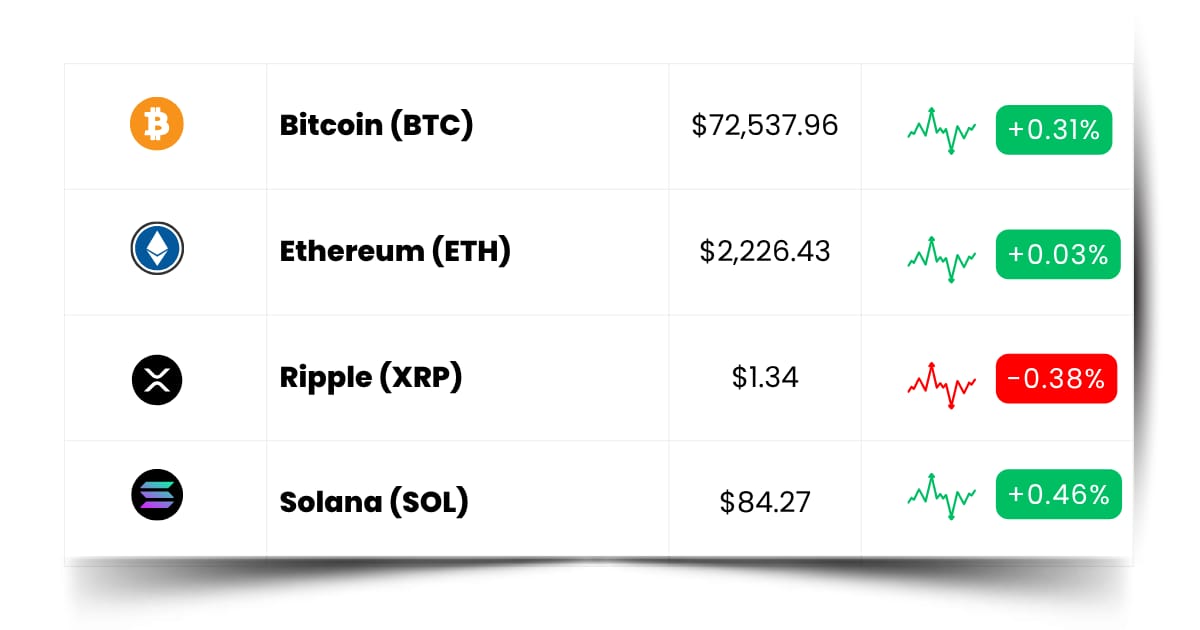
Crypto Pulse
Bitcoin is holding steady as volatility compresses, but beneath the surface, momentum is already breaking out in smaller, higher-risk names.
RaveDAO surged 331.9%, MagmaFinance jumped 59%, and Aria.AI climbed 37.6% as traders rotated into niche narratives and low-liquidity setups.
These are not broad market moves. They are sharp bursts of capital chasing specific themes.
That contrast matters.
While Bitcoin remains locked in a tight range waiting for a catalyst, speculative capital is already active at the edges of the market, where moves are faster, and conviction is shorter-term.
This is a familiar split. The top of the market is pausing, while the bottom is already moving.
RaveDAO (RAVE) $1.47 (+224.02%)
RAVE exploded higher as traders piled into ultra-high momentum, with rapid volume expansion suggesting aggressive speculative positioning.
MagmaFinance (MAGMA) $0.2202 (+29.66%)
RAVE exploded higher as traders piled into ultra-high momentum, with rapid volume expansion suggesting aggressive speculative positioning.
Aria.AI (ARIA) $0.4273 (+19.53%)
ARIA climbed as traders leaned into AI-linked narratives, with momentum building around early-stage positioning and thematic demand.
Energy Shift (Sponsored)
Oil has moved above $100 a barrel as tensions in the Middle East continue to reshape expectations across global energy markets.
While daily headlines can drive sharp swings, the bigger story may be what higher crude prices mean for select energy companies with strong cash flow and operating leverage.
Zacks has outlined three oil stocks that may be well positioned if elevated prices persist.
Read the report.
Future Forward
The next phase of the market rarely announces itself all at once. It shows up in fragments.
You see it in where attention is starting to build, in the protocols attracting early users, and in how capital moves the moment new tokens go live. These signals tend to repeat before they become obvious.
Airdrops follow participation, not hype. Users who interact early, bridge funds, stake, and stay active are usually the ones positioned before the wider market catches on.
Token launches are where those early signals get tested. The first few days tell you whether demand is real, liquidity can hold, and whether interest survives once volatility picks up.
If you are watching closely, the next cycle does not arrive as a surprise. It builds in plain sight.
Crypto Conferences:
💎 The crypto Generational Wealth Workshop (April 11)
💎 Bit Block Boom 2026 (April 12)
💎 Commerce Interact Blockchain Forum (April 13)
Upcoming Airdrops:
🎁 Tradoor (TRADOOR) Airdrop (April 15, 2026)
🎁 SoSoValue (SOSO) Airdrop (May 2026)
Upcoming Token Launches:
🚀 One Football (OFC) TGE (April 9, 2026)
🚀 Wingbits TGE (April 22, 2026)
Which event are you most excited for? Let us know!
Crypto Know-How: What Low Volatility Is Really Telling You
When markets go quiet, most traders assume nothing is happening, but that’s usually when something is building.
Low volatility does not mean low risk. It often means the opposite. It signals a market where positioning is stacking up, conviction is forming, and pressure is building beneath the surface.
That is exactly what happens during compression phases.
As prices tighten into a narrow range, traders start leaning one way. Some build long positions in anticipation of a breakout.
Others are in a position to be rejected. Liquidity clusters around key levels, and the market becomes more sensitive to any new information.
When the price finally moves, it is not just driven by new buyers or sellers. It is driven by the forced unwinding of positions that were built during the quiet period.
Take: Don’t mistake calm for safety. When volatility compresses and positioning builds, the next move is usually sharper, faster, and more reactive than most expect.
Everything Else
A company does not raise its dividend for 50 consecutive years by accident and a new free report just identified 7 of them, including one healthcare name that has been hiking payouts for 61 straight years.
Flare has proposed a major protocol overhaul to capture MEV at the network level, redirecting value into token buybacks and burns while cutting inflation to 3%. The move aims to shift revenue away from external actors and strengthen long-term token economics.
U.S. Treasury officials have reportedly met with major bank leaders to assess the cybersecurity risks posed by advanced AI models, following concerns that Anthropic’s latest system could expose critical vulnerabilities at scale. The move highlights growing fears that AI-driven threats could impact financial stability and core infrastructure.
Coinbase has updated its x402 protocol to support usage-based payments, allowing AI agents to pay for compute resources dynamically rather than through fixed fees. The move aims to better support agentic AI and real-time, demand-driven transactions.
When the market looks calm on the surface, it usually means something is building beneath the surface.
Volatility is compressing, institutions are stepping further into control, and enforcement is becoming faster and more coordinated. These are not isolated shifts. They are signals of a market evolving in real time.
Stay focused on where pressure is building, who is shaping access, and how risk is being managed.
Best Regards,
— Benjamin Vitaris
Crypto Intel