- Crypto Intel
- Posts
- The $72K Breakout, the SEC's Green Light, and a $35M Stablecoin Bet
The $72K Breakout, the SEC's Green Light, and a $35M Stablecoin Bet
Three signals that crypto is moving from speculation toward infrastructure.
Bitcoin just pushed through $72K even as the US dollar strengthened, the SEC signaled a green light for tokenized stocks, and Alibaba backed a $35M stablecoin expansion.
If you are deciding whether to lean into momentum, front-run tokenization, or position for stablecoin infrastructure growth, this week hands you a clear roadmap.
Crypto is not just reacting to price anymore—it's colliding with policy, Wall Street plumbing, and global payment rails.
That shift directly impacts how you allocate risk over the next quarter, not just the next trade.

Early Access (Sponsored)

When SpaceX goes public, it could hit a $1.5 TRILLION valuation - that would be 3,000 times bigger than Amazon's IPO.
Most investors will be locked out until AFTER the big announcement.
But I've discovered a "backdoor" that lets you grab a pre-IPO stake in SpaceX right now.
I'm revealing the ticker for free.
Market-Moving News
This is not a quiet grind higher—it is a structural shift week.
Bitcoin reclaimed $72K against macro pressure, regulators moved closer to on-chain equities, and stablecoin infrastructure attracted serious corporate capital.
In the short term, you are trading breakouts and derivatives positioning.
In the bigger picture, you are watching the foundations of how stocks, dollars, and crypto interact start to rewire in real time—and that changes where smart capital wants to sit next.
Markets
Bitcoin Pushes Above $72K as Dollar Strength Fails to Cap Crypto Rally
Bitcoin climbed 2% since midnight UTC to break through $72,000, outperforming Nasdaq 100 and S&P 500 futures even as the US Dollar Index moved above 100.
In most cycles, a stronger dollar pressures risk assets, but this time, crypto ignored the script.
Futures open interest across the industry rose 5% to $107.6 billion, showing fresh capital entering rather than traders simply rotating.
Bitcoin open interest jumped to 687,200 BTC, its highest since Feb. 25, while Ether reached 13.72 million contracts.
Derivatives Signal Bullish Bias
Funding rates and cumulative volume deltas remain positive for Bitcoin and Ether, pointing to a clear tilt toward bullish positioning.
XRP open interest surged nearly 10% to $1.86 billion, with SOL, ADA, and SUI also seeing notable increases.
Bitcoin's 30-day implied volatility dropped to 55%, a two-week low that historically supports steady spot advances.
On Deribit, puts remain pricier than calls for Bitcoin, though the long-end premium in Ether has nearly disappeared.
Altcoins and AI Join the Move
TRUMP jumped over 30% after announcing a gala event for top token holders, injecting memecoin energy back into the tape.
AI tokens TAO and FET each gained about 14%, and the Altcoin Season Index climbed to 40/100.
One notable laggard was Canton, down 4% on the day and 11% over the month. Strength remains concentrated in high-beta narratives rather than evenly distributed across the market.
Take: You are seeing Bitcoin hold firm despite macro headwinds and a stronger dollar, which suggests underlying demand is real.
A high-volume break above $74,000 could open the path toward $80,000, but if momentum fades, expect range trading to resume quickly.
Policy
SEC Advisory Committee Backs Tokenized Securities Framework
An advisory committee to the SEC voted to support moving forward with a tokenized securities framework that would allow blockchain-based stock trading under specific conditions.
The proposal calls for narrow exemptions paired with mandatory disclosures and routine supervision.
SEC Chairman Paul Atkins said the agency is already working toward formal guidance and may soon consider an innovation exemption.
That signals tokenization is shifting from theory to regulatory design.
How Tokenized Trading Could Change Markets
Traditional stock trades rely on brokers, transfer agents, and centralized settlement systems that can take a day or more to finalize.
On-chain tokenized equities could settle instantly, with ownership recorded directly on a blockchain.
The committee emphasized that tokenized equities still meet the legal definition of securities, meaning investor protections must mirror the traditional system.
It warned that poorly structured exemptions could introduce new risks or hidden costs for investors.
Atkins praised the efficiency gains of tokenization, including reduced settlement risk and fewer intermediaries.
He indicated the Commission may allow limited trading of certain tokenized securities while building a longer-term framework.
Take: You are watching regulators cautiously open the door to blockchain-based stock trading without abandoning traditional safeguards.
If done carefully, this could legitimize on-chain equities and attract serious capital, but the pace will depend on how tightly the SEC balances innovation with investor protection.
Trivia: Which major investment firm launched one of the largest spot Bitcoin ETFs in 2024? |
Big Shift (Sponsored)

For decades, one type of investment was reserved for the ultra-wealthy.
Then Trump signed Executive Order 14330 - and opened it to everyone.
Now you can get into this boom for less than $20.
See what changed
Stablecoins
Alibaba Backs MetaComp's $35M Raise to Expand Stablecoin Network
Singapore-based MetaComp completed a new funding round backed by Alibaba, bringing total capital raised to $35 million across two rounds in three months.
The latest raise also included Spark Venture, with 100Summit Partners advising.
MetaComp plans to use the capital to expand its StableX Network, which connects regulated institutions and stablecoin issuers through blockchain infrastructure.
The company targets growth across Asia, the Middle East, Africa, and Latin America.
Bridging Fiat and Stablecoins
Founded in 2018, MetaComp offers hybrid fiat and stablecoin payment solutions alongside access to traditional and tokenized wealth products.
Its StableX Network is designed to enable compliant, real-time cross-border settlement.
Alibaba's involvement is notable given China's ongoing restrictions on domestic stablecoin issuance.
The Chinese government recently reiterated that companies cannot issue stablecoins pegged to the national currency without approval.
Investor interest in regulated stablecoin infrastructure appears to be accelerating across Asia.
Institutions, including Standard Chartered, have projected that the stablecoin market could reach $2 trillion by 2028.
Take: You are seeing major corporate players quietly position themselves around regulated stablecoin rails rather than speculative tokens.
If cross-border settlement demand continues to grow, infrastructure providers like MetaComp could benefit from structural adoption, though regulatory clarity in Asia will remain a key variable.
Coin Leaderboard
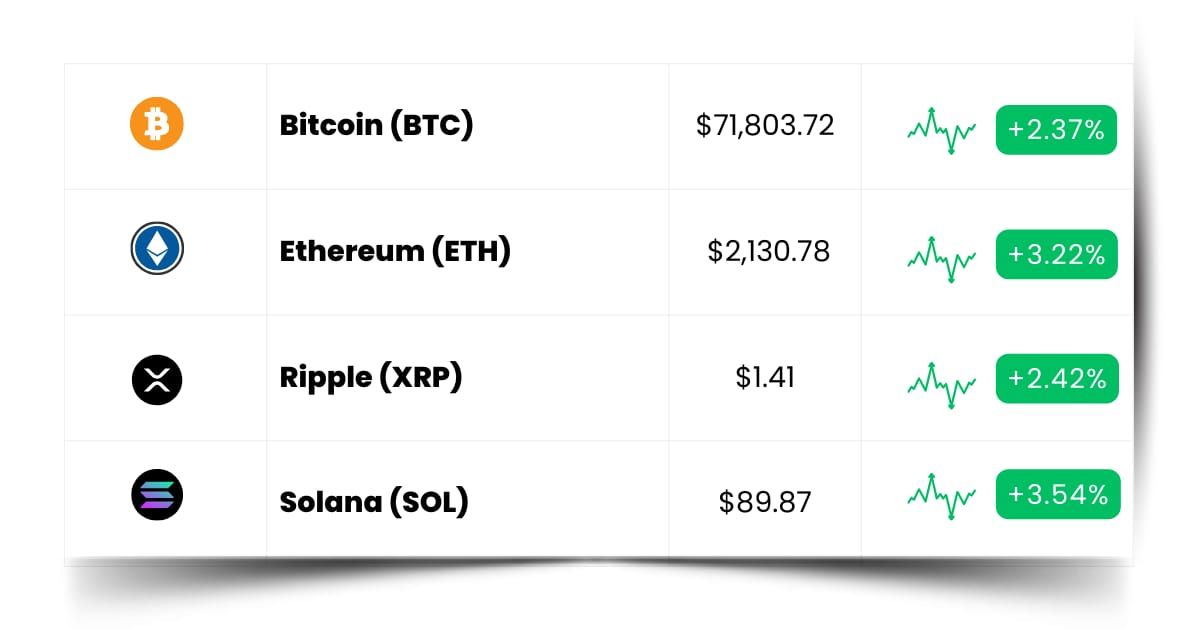
Crypto Pulse
Bitcoin just reclaimed $72K against a rising US dollar, regulators are inching toward tokenized stocks, and global banks are leaning into stablecoin rails—yet TRUMP exploded 53%, PIXEL stacked another 32%, and LYN bounced 26% in a single day.
That is your current market: structural shifts in the background, high-beta momentum in the foreground, and traders switching gears faster than the headlines can keep up.
This is not random chaos—it is capital expressing two views at once.
Long-term money is positioning for tokenized equities and regulated stablecoins, while short-term traders are squeezing volatility wherever it appears.
OFFICIAL TRUMP (TRUMP) $3.78 (+37.08%)
TRUMP dominated today's Crypto Pulse, ripping 37.08% higher as memecoin momentum snapped back into the market.
Pixels (PIXEL) $0.01424 (+31.42%)
PIXEL extended its March 10 breakout with another 31.42% move.
Everlyn AI (LYN) $0.3023 (+30.20%)
LYN rebounded 30.20% over the past 24 hours after a sharp pullback, signaling dip buyers were waiting for a reset.
Free Report (Sponsored)
While many stocks stall, a small group is quietly strengthening.
Five companies just earned spots in a new high-upside report — each showing rare alignment between fundamentals and momentum.
Previous editions produced triple-digit winners¹.
Free access ends tonight.
See all 5 here
*Results may not represent all stock picks and may reflect partially closed positions. Investing involves risk, and past performance does not guarantee future results. This is not financial advice.
Future Forward
If you only show up when Crypto Twitter is euphoric, you are usually exiting liquidity.
The real edge lives earlier—inside conference halls, testnets, Discord servers, and product demos that have not hit your timeline yet.
Crypto conferences are not just networking events—they are signal farms.
When you see which booths are swarmed, which side events are oversubscribed, and which ecosystems developers keep name-dropping, you are getting a preview of where attention and capital might rotate next.
Airdrops are rarely about luck.
They reward the people who actually use the product—bridging assets, staking tokens, voting on proposals, breaking things in beta, and giving feedback before there is a token price attached.
Token launches are the stress test. That first week of trading shows you whether the community was real or rented, and whether liquidity backs the story—or exposes it.
Crypto Conferences:
💎 TOKENIQ 2026 (Mar 14, 2026)
💎 Instant Payments and Beyond Summit Atlanta (Mar 16, 2026)
💎 Global Game Connect 2026 (Mar 16, 2026)
Upcoming Airdrops:
🎁 Stargaze (STARS) Airdrop (Mar 17, 2026)
🎁 SoSoValue (SOSO) Airdrop (May 2026)
Upcoming Token Launches:
🚀 Mezo TGE and Distribution (Q1 2026)
🚀 EarnPark (PARK) Token Sale (Apr 13, 2026)
🚀 EarnBIT (EBT) TGE and Distribution (Q2 2026)
Which event are you most excited for? Let us know!
Crypto Know-How: What Is Kalshi?
Kalshi is a regulated US-based prediction market where you can trade on the outcome of real-world events.
Instead of buying stocks or crypto, you buy contracts that pay out if something specific happens—like an interest rate cut or a political result.
Each contract usually trades between $0 and $1, representing the probability of that outcome.
If you buy at $0.40 and the event happens, the contract settles at $1, and you keep the difference as profit.
Kalshi operates under oversight from the CFTC, which treats many of these contracts as financial derivatives rather than traditional gambling.
That regulatory structure is exactly why prediction markets are now at the center of policy debates in Washington.
For you as a crypto-native reader, Kalshi matters because it sits at the crossroads of trading, regulation, and event-based speculation.
As lawmakers argue over where prediction markets fit, the rules they write could shape how similar platforms—both in traditional finance and crypto—operate in the US.
Everything Else
The CFTC issued new guidance and launched a formal rulemaking review on prediction markets, signaling it plans to defend its jurisdiction over event contracts as states and lawmakers debate whether sports-based markets should be treated as financial derivatives or gambling.
Yield-bearing stablecoins are growing 15 times faster than the broader stablecoin market, with products like USYC, USDG, USDD, and USDY driving a surge to $22.7 billion in supply even as US lawmakers remain divided over how crypto-linked yield should be regulated.
The Bank of England signaled a softer stance on stablecoins and said it is open to revisiting proposed holding limits, but officials argue they still lack concrete, workable alternatives from industry participants on how to manage deposit flight risks.
Hong Kong is reportedly preparing to issue its first stablecoin licenses as early as March 24, with HSBC and Standard Chartered tipped to be among a very small initial group approved under the city's new Stablecoin Ordinance.
The Bitcoin Policy Institute said it will challenge the Federal Reserve's implementation of Basel rules that assign Bitcoin a 1,250% risk weight, arguing the current framework treats Bitcoin more harshly than most asset classes and makes it costly for banks to hold.
Instead of sprinting after vertical candles, build a system that gets you closer to the source—roadmaps, communities, and early user incentives.
The next breakout won't arrive with fireworks; it will start as a calendar event, a testnet quest, or a quiet launch window that only attentive players notice.
Best Regards,
— Benjamin Vitaris
Crypto Intel